






Can Ca-AKG Replicate the Benefits of Caloric Restriction?
Caloric restriction is the most consistently replicated longevity intervention in biology. In controlled studies, cutting caloric intake by 20 to 40 percent has extended lifespan by up to 50 percent in some organisms, and slowed biological aging in humans. The problem is equally consistent. Most people won't sustain it long-term, and extreme restriction comes with real physiological trade-offs.
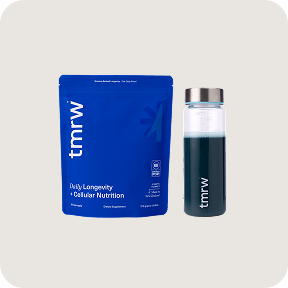
Ca-AKG appears to activate the same core longevity pathways, without the caloric restriction. Tmrw contains 1,000mg per scoop. Here's what the research shows.
What is Ca-AKG?
Calcium alpha-ketoglutarate is the calcium salt form of alpha-ketoglutarate (AKG), an organic acid the body produces naturally through the Krebs cycle. The Krebs cycle is the core mitochondrial process that converts nutrients into ATP, the energy currency every cell depends on.
AKG sits at a central junction in this cycle. It feeds into multiple downstream reactions and serves as a cofactor for enzymes that regulate gene expression and cellular maintenance. It's not a fringe molecule. It's one the body actively synthesizes and depends on.
The calcium form improves bioavailability compared to AKG in its free acid form, and it's the version used in the most cited human research on this molecule.
The decline question
Unlike most supplements, AKG isn't primarily obtained through diet. The body makes it. Which means the question of how its levels change over time is really a question about internal production, not nutrition.
Research shows that circulating AKG levels fall significantly with age, with some estimates suggesting a more than tenfold decline between young adulthood and later life. That's a substantial shift in the concentration of a molecule that touches energy metabolism, epigenetic regulation, and cellular maintenance simultaneously.
Whether that decline drives aging or simply accompanies it is still being worked out. What the research does support is that the relationship is real, and that the drop in AKG levels coincides with a range of changes in cellular function that longevity science is actively trying to address.
The caloric restriction connection
When researchers study why caloric restriction extends lifespan, two pathways keep coming up: mTOR and AMPK.
mTOR promotes cell growth. When it's chronically overactivated, the research links it to accelerated aging and age-related disease. Caloric restriction suppresses mTOR, which is part of why it works.
AMPK does the opposite. It signals that energy is scarce and kicks off cellular maintenance, including autophagy, the system that clears out damaged proteins and organelles before they cause problems.
Suppressing mTOR and activating AMPK at the same time is essentially what caloric restriction does at the pathway level. Research published in Aging found that AKG produces this same effect. The pathways involved are fundamental to how the body regulates aging, which is why this finding drew significant attention from longevity researchers.
The biological age data
The most striking human evidence on Ca-AKG comes from a 2021 study published in Aging.
Forty-two individuals took a Ca-AKG formulation for an average of seven months. Biological age, measured using the TruAge DNA methylation clock, showed an average reduction of 8 years.
That result is worth sitting with. DNA methylation clocks measure biological age by analyzing chemical modifications across the genome that shift in predictable patterns as cells age. They're one of the most validated tools available for quantifying how fast someone is aging at the cellular level - and they're increasingly used in longevity research precisely because they capture something chronological age doesn't.
What it does offer is a meaningful signal. The epigenetic mechanisms AKG supports at a molecular level appear to translate into measurable shifts in biological age in humans. The ABLE trial, a double-blind placebo-controlled study using 1g of Ca-AKG in adults aged 40 to 60, was designed to test exactly this.

What else the science shows
Ca-AKG doesn't operate through a single mechanism. The mTOR and AMPK activity sits alongside several other well-documented effects.
Epigenetic regulation:
AKG is a required cofactor for TET enzymes and histone demethylases, the enzymes that regulate DNA methylation patterns. Healthy methylation is one of the clearest markers of biological youth.
Without sufficient AKG, these enzymes can't function properly. This is likely part of the mechanism behind the biological age reductions seen in the 2021 study, and it connects Ca-AKG's pathway activity to something measurable in humans.
Mitochondrial function:
As a Krebs cycle intermediate, AKG directly supports mitochondrial energy production. When AKG levels fall, the efficiency of the cycle drops with it. A 2025 study found that AKG attenuates oxidative stress-induced neuronal aging through mTOR pathway modulation, adding to the evidence for its protective role in cellular energy systems.
Inflammation:
AKG has been shown to reduce systemic inflammatory cytokines, partly through induction of IL-10, an anti-inflammatory signaling molecule. Chronic low-grade inflammation is one of the more recognized drivers of age-related decline, and this aspect of AKG's profile reinforces its broader role in the aging picture.
Caloric restriction without the caloric restriction
The appeal of caloric restriction has always been the mechanism, not the diet itself. Suppressing mTOR, activating AMPK, promoting autophagy: these are biological processes with strong, well-replicated links to healthspan extension. The difficulty is sustaining the diet long enough to benefit.
Caloric restriction mimetics are molecules that activate the same pathways without the dietary restriction. Ca-AKG is one of the more mechanistically grounded candidates, with pathway research and early human biological age data pointing in the same direction.
It's not a substitute for healthy nutrition, but it addresses pathways that longevity science consistently returns to, at a dose matched to what appears in the research.
Why 1,000mg and why it's in Tmrw
Tmrw includes 1,000mg of Ca-AKG per daily scoop, matching the dose used in the ABLE placebo-controlled trial. The formulation was built around doses that appear in the research, not doses chosen for cost efficiency.
Ca-AKG sits within Tmrw's NAD+ and cellular energy complex alongside NMN, D-Ribose, PQQ, Urolithin A, and Acetyl L-Carnitine. Its mTOR and AMPK activity reinforces and complements the broader formula. Like every ingredient in Tmrw, it's selected for what it does across multiple hallmarks of aging, not just one.
It's one of 88 ingredients doing that work in every scoop.
Tmrw contains 88 longevity ingredients, including 1,000mg of Ca-AKG, formulated to address all 12 hallmarks of aging. NSF Certified for Sport. Made in New Zealand.